
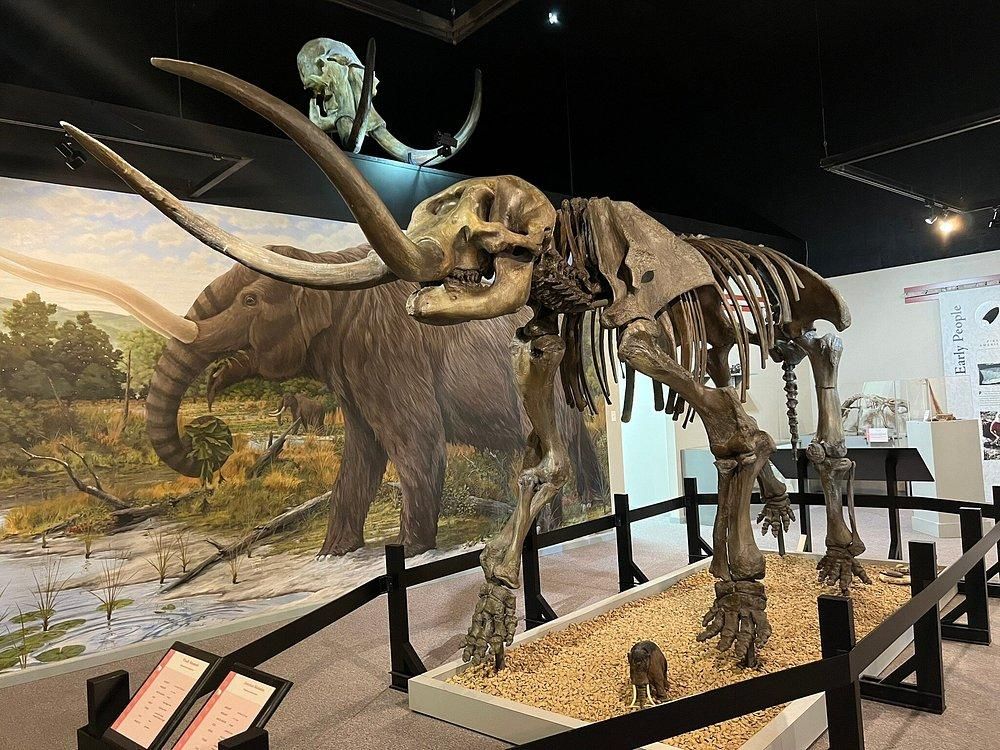
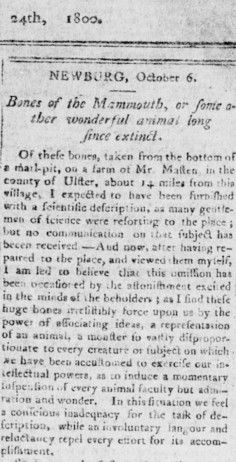
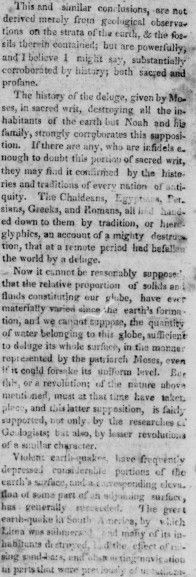
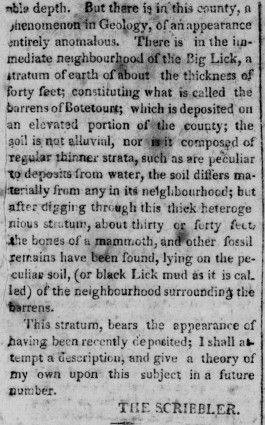
Couldn’t find any more information on this find in Roanoke, but mammoths have been found at other salt licks, including Saltville, VA; Wythe, VA (Wytheville?); and Thomas Jefferson’s favorite, Big Bone Lick, in KY. The first shipment of Jefferson’s excavated bones is on the bottom of the Mississippi River, the boats having sunk. The author seems sold on Catastrophism; he would have loved Noah’s Ark World or whatever it’s called in Kentucky. It’s a pity that local residents just carried off the bones and teeth; who knows where they ended up.
“There is in the immediate neighbourhood of the Big Lick, a stratum of earth of about the thickness of forty feet; constituting what is called the barrens of Botetourt, which is deposited on an elevated portion of the county; the soil is not alluvial, nor is it composed of regular thinner strata, such as are peculiar to deposits from water, the soil differs materially from any in its neighbourhood; but after digging through this thick heterogeneous stratum, about thirty or forty feet, the bones of a mammoth, and other fossil remains have been found, lying on the peculiar soil, (or black Lick mud as it is called) of the neighbourhood surrounding the barrens.”
The museums below have exhibits on the local finds
Saltville Museum of the Middle Appalachians
https://museumofthemiddleappalachians.org/
Virginia Living Museum
https://thevlm.org/virginia-mammoths/
Virginia Museum of Natural History
https://www.vmnh.net/
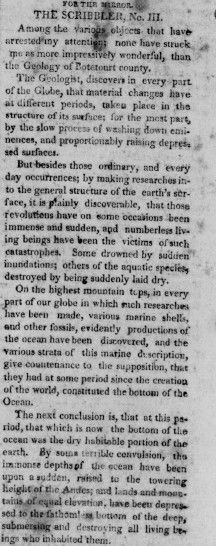
THE SCRIBBLER, No. VI.
Among the various objects that have arrested my attention, none have struck me as more impressively wonderful, than the Geology of Botetourt county.
The Geologist, discovers in every part of the Globe, that material changes have at different periods, taken place in the structure of its surface; for the most part, by the slow process of washing down eminences, and proportionally raising depressed surfaces.
But besides these ordinary, and every day occurrences, by making researches into the general structure of the earth’s surface, it is plainly discoverable, that those revolutions have on some occasions been immense and sudden, and numberless living beings have been the victims of such catastrophies. Some drowned by sudden inundations, others of the aquatic species destroyed by being suddenly laid dry.
On the highest mountain tops, in every part of our globe in which such researches have been made, various marine shells, and other fossils, evidently productions of the ocean have been discovered; and the various strata of this marine description, give countenance to the supposition, that they had at some period since the creation of the world, constituted the bottom of the Ocean.
The next conclusion is, that at this period, that which is now the bottom of the ocean, was the dry habitable portion of the earth. By some terrible convulsion, the immense depths of the ocean have been upon a sudden, raised to the towering height of the Andes, and lands and mountains of equal elevation, have been depressed to the fathomless bottom of the deep, submersing and destroying all living beings who inhabited them.
This and similar conclusions, are not derived merely from geological observations on the strata of the earth, & the fossils therein contained, but are powerfully, and I believe I might say, substantially corroborated by history, both sacred and prophane.
The history of the deluge, given by Moses, in sacred writ, destroying all the inhabitants of the earth but Noah and his family, strongly corroborates this supposition: if there are any, who are infidels enough to doubt this portion of sacred writ, they may find it confirmed by the histories and traditions of every nation of antiquity. The Chaldeans, Egyptians, Persians, Greeks, and Romans, all had handed down to them by tradition, or hieroglyphics, an account of a mighty destruction, that at a remote period had befallen the world by a deluge.
Now it cannot be reasonably supposed that the relative proportion of solids and fluids constituting our globe, have ever materially varied since the earth’s formation, and we cannot suppose, the quantity of water belonging to this globe, sufficient to deluge its whole surface, in the manner represented by the patriarch Moses, even if it could forsake its uniform level: For this, or a revolution, of the nature above mentioned, must at that time have taken place; and this latter supposition, is fairly supported, not only by the researches of Geologists, but also, by literal revolutions of a similar character.
Violent earth quakes have frequently depressed considerable portions of the earth’s surface, and a corresponding elevation of some part of its adjoining surface, has generally succeeded. The great earth quake in South America, by which Lima was submersed, and many of its inhabitants destroyed, had the effect of raising sand bars, and obstructing navigation in parts that were previously of a great undeterminable depth. But there is in this county, a phenomenon in Geology of an appearance entirely anomalous. There is in the immediate neighbourhood of the Big Lick, a stratum of earth of about the thickness of forty feet; constituting what is called the barrens of Botetourt; which is deposited on an elevated portion of the county; the soil is not alluvial, nor is it composed of regular thinner strata, such as are peculiar to deposits from water, the soil differs materially from any in its neighbourhood; but after digging through this thick heterogeneous stratum, about thirty or forty feet, the bones of a mammoth, and other fossil remains have been found, lying on the peculiar soil, (or black Lick mud as it is called) of the neighbourhood surrounding the barrens.
This stratum, bears the appearance of having been recently deposited, I shall attempt a description, and give a theory of my own upon this subject in a future number.
Extract of a letter from a gentleman, dated Wythe, Virg. Dec. 27, 1805.
“I cannot omit amusing you, with some items of a late discovery in this county. About two miles east of Gen. Wampler’s, an attempt was made, to sink a pit, to search for salt water. A few feet below the surface, have been found several bones of the mammoth of an unusually large size.
One tooth is said to weigh 17lb. and proves it to be a creature that fed on herbage. With these bones are intermixed a number of that of an animal of the largest species-of the carnivorous kind, also a number of bones of young or smaller mammoths; and one might conjecture from appearances, that these carcases have not been more than one hundred years deposited in the earth.
Entire pieces of reed, six inches long, and twigs of the pine tree, are found in a large bed of dung, supposed to have been in the intestines of the mammoth, when it was killed. Our acquaintance, the Rev. Mr. Stanger, is busy in good weather, in having a full search made, for the whole skeleton, which if he succeeds, it probably will give further information concerning the nature and properties of a species of animals now extinct.”
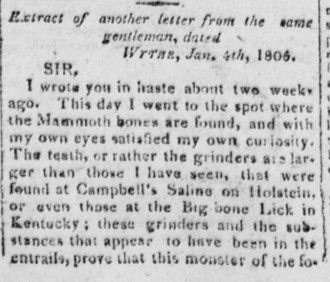
Extract of another letter from the same gentleman, dated Wythe, Jan. 4th, 1806.
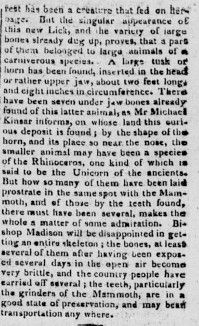
SIR, I wrote you in haste about two weeks ago. This day I went to the spot where the Mammoth bones are found, and with my own eyes satisfied my own curiosity. The teeth, or rather the grinders are larger than those I have seen, that were found at Campbell’s Saline on Holstein, or even those at the Big bone Lick in Kentucky; these grinders and the substances that appear to have been in the entrails, prove that this monster of the forest has been a creature that fed on herbage. But the singular appearance of this new Lick, and the variety of large bones already dug up, proves, that a part of them belonged to large animals of a carnivorous species. A large tusk or horn has been found, inserted in the head or rather upper jaw, about two feet long, and eight inches in circumference. There have been seven under jaw bones already found of this latter animal, as Mr. Michael Kinser informs, on whose land this curious deposit is found; by the shape of the horn, and its place so near the nose, the smaller animal may have been a species of the Rhinoceros, one kind of which is said to be the Unicorn of the ancients. But how so many of them have been laid prostrate in the same spot with the Mammoth, and of those by the teeth found, there must have been several, makes the whole a matter of some admiration. Bishop Madison will be disappointed in getting an entire skeleton; the bones, at least several of them after having been exposed several days in the open air became very brittle; and the country people have carried off several; the teeth, particularly the grinders of the Mammoth, are in a good state of preservation, and may bear transportation any where.