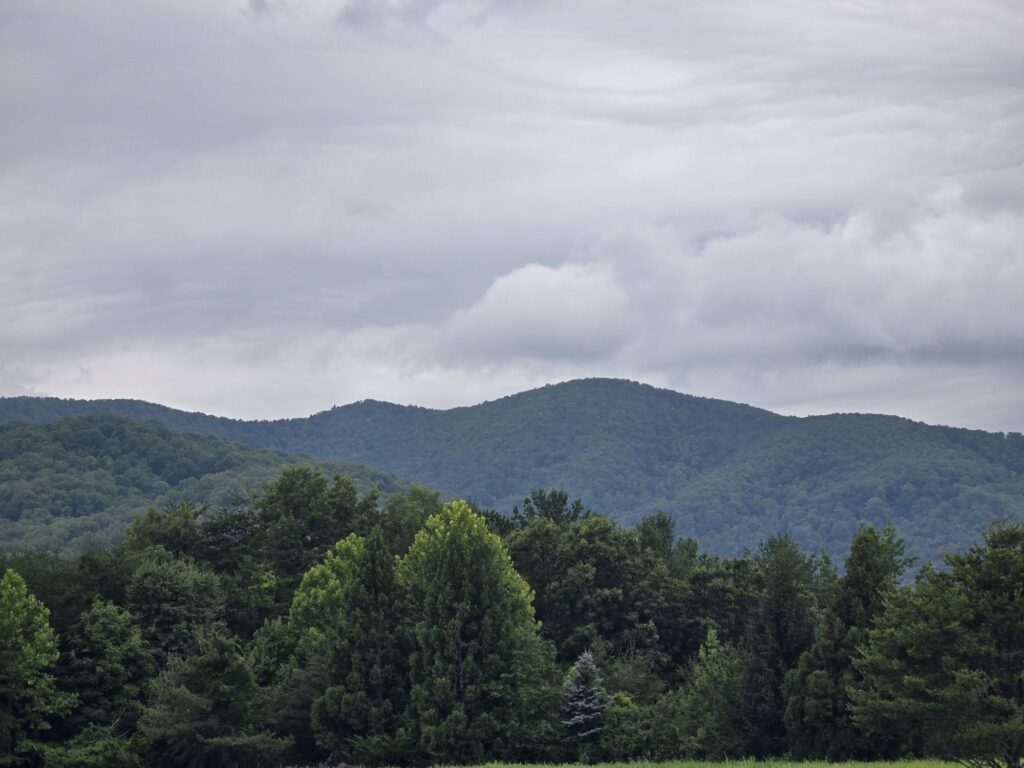
Rain all evening.
The kind of rain that turns the Blue Ridge into a dark smudge beyond the window. I’ve been listening to Old Gods of Appalachia while watching the ridgeline disappear and reappear through the weather, and it got me thinking about how closely the fictional world of the podcast sometimes seems to echo the history and geography of Roanoke, Virginia, my current stomping grounds.
There is an uncomfortable familiarity to the show’s treatment of Appalachian industry. Its stories of railroads, coal, corporate power, family fortunes, and ancient things lurking beneath the mountains take the real history of Appalachia and push it into the realm of cosmic horror. The fictional Locke family and the tragic Benji Rigg inhabit an alternate Appalachia, but the landscape underneath their stories feels remarkably familiar.
Roanoke doesn’t need much embellishment to serve as a backdrop for that kind of story. The city was built around the railroad, grew rapidly during the industrial boom, and accumulated the kind of wealth and architecture associated with the Gilded Age. Its history is literally embedded in the landscape.
So I decided to see what would happen if I stopped treating the similarities as an impression and put them on an actual map.
I wasn’t looking for exact one-to-one equivalents. Penderyn isn’t secretly sitting somewhere outside Roanoke, and there isn’t a real Furnace beneath Mill Mountain. Instead, I wanted to identify places where the fictional geography and the real geography seem to jibe.
The first point on the map was the historic Virginian Railway Station on South Jefferson Street.
That is an obvious place to begin with Benji Rigg. His story is intertwined with railroad tracks, stations, yards, and the sprawling machinery of the Locke Railroad Company. Roanoke’s own history is inseparable from the railroad. Norfolk and Western transformed the city from a small settlement into an important industrial and transportation center, and for generations the railroad influenced virtually every aspect of life here.
The old station provides an especially evocative physical reminder of that history. On a rainy evening, surrounded by brick, steel, wet pavement, and the dark outline of the mountains, it is easy to understand why railroads work so well as the setting for Appalachian horror. The whistle of a distant train doesn’t require much imagination to become something more ominous.
From there, the map moves downtown to the old Norfolk and Western General Office Buildings.
These buildings provide a useful real-world counterpart to the administrative power represented by the fictional Locke empire. Their imposing brick facades convey the scale of an organization that could influence an entire city and reach far beyond it. A railroad empire was not simply trains and tracks. It was land, labor, money, housing, commerce, and an enormous bureaucratic structure capable of turning individual lives into numbers on a ledger.
The old rail yard areas become another point on the map, connecting the physical machinery of the railroad with the offices where decisions were made.
From there, the map naturally leads to the places where the wealth generated by that industrial expansion became visible.
The Hotel Roanoke is one obvious stop. Built during the city’s railroad boom, it represents the other side of the industrial story: the hotels, meetings, social connections, and accumulated wealth that accompanied the growth of the railroad economy.
Old Southwest provides another useful piece of the puzzle. Its historic homes and Victorian architecture offer a glimpse of the prosperity that developed during Roanoke’s period of rapid expansion. It isn’t Penderyn, and there is no reason to pretend that it is. But if Penderyn represents the way great fortunes can conceal something darker beneath their polished surfaces, Old Southwest provides a real architectural reminder of what those fortunes looked like above ground.
Then the map turns toward Mill Mountain.
This is where the comparison becomes more geological than historical.
The Furnace beneath Penderyn is fictional, but the idea of a hidden world beneath the surface isn’t particularly difficult to imagine in the Roanoke Valley. The region’s geology includes karst limestone, with caves, fissures, underground drainage, and other features created by the slow movement of water through soluble rock.
The ground here is not always as solid or as simple as it appears.
Mill Mountain makes an especially effective landmark for this imagined geography. Sitting within the city itself, it provides a physical center around which much of Roanoke’s landscape can be understood. From Mill Mountain Park and the Roanoke Star, the relationship between the city, the railroad corridors, the surrounding neighborhoods, and the mountains becomes immediately visible.
On a clear day, it is simply a spectacular view.
On a rainy evening, when clouds settle into the valley and the lights of the city appear beneath them, the mountain can take on a different character. It becomes easy to imagine it as something old and patient, watching everything built around it.
The map doesn’t stop at the city limits.
Following the same progression that appears so often in Appalachian stories, it eventually moves away from the developed landscape and toward the woods. That means heading toward Salem, Dutch Oven Road, and the Hanging Rock area.
The Hanging Rock Battlefield Trail is particularly well suited to the atmosphere. The combination of rocky terrain, water, old stone, dense trees, and relative quiet creates a landscape that feels distinctly Appalachian. It is the sort of place where the transition between civilization and wilderness becomes noticeable.
That transition is important to the stories.
Cities have boundaries. Property has boundaries. Companies have boundaries. The woods don’t recognize any of them.
By the time the fictional world reaches those kinds of places, the authority of people and institutions begins to feel increasingly irrelevant. Money cannot buy the mountains. A railroad cannot impose a timetable on the forest. A deed cannot tell the things living beyond its boundary where they are allowed to go.
That is where the real geography and the fictional horror begin to overlap most effectively.
By the time I finished placing the points, the route on the map looked almost like a rough outline of the story:
Virginian Railway Station → Norfolk & Western General Offices → old rail yards → Hotel Roanoke → Old Southwest → Mill Mountain → Salem → Hanging Rock
It isn’t a map of Old Gods of Appalachia. It isn’t evidence that the fictional locations were based on Roanoke.
It’s a map of Roanoke itself, and that’s what makes it interesting to me.
The railroad is real. The industrial fortunes are real. The old corporate buildings are real. The houses built during the city’s boom are real. The mountain is real. The limestone is real. The woods are real.
The fictional stories simply rearrange those ingredients and ask what might happen if the darkness beneath them were literal.
Perhaps that’s one of the reasons Appalachian horror works so well. It doesn’t have to invent an entirely unfamiliar landscape. It can take places that already have complicated histories and simply change the way we look at them.
Tonight, the rain has swallowed most of the Blue Ridge. Mill Mountain is barely visible through the window, just a dark shape behind the lights of the city. Somewhere beyond it, the railroad is still running through the valley.
On the map, the locations are just pins.
In reality, they are streets, buildings, neighborhoods, mountains, trails, and woods.
All of them sitting on the same ground, and that leaves one unsettling thought behind.
Maybe the frightening part isn’t imagining that something ancient is hiding beneath Roanoke.
Maybe it’s realizing that if something were down there, we wouldn’t have built the city around it – we would have built the city directly on top of it.
Current Mood: Watching the mountains disappear in the rain.
Current Music: Old Gods of Appalachia