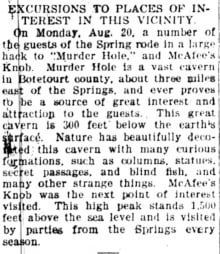
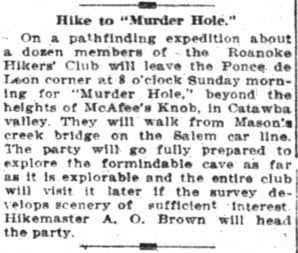
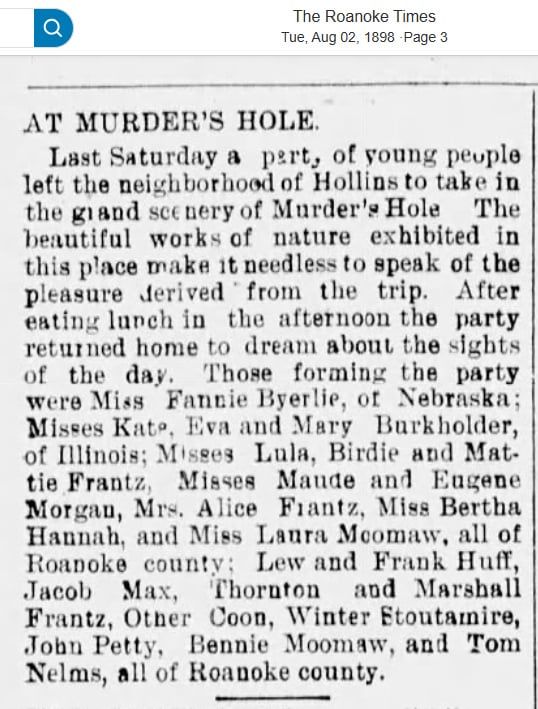
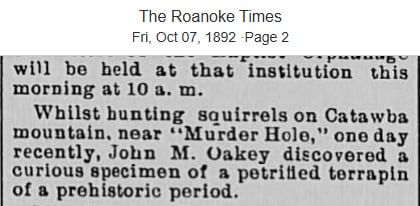
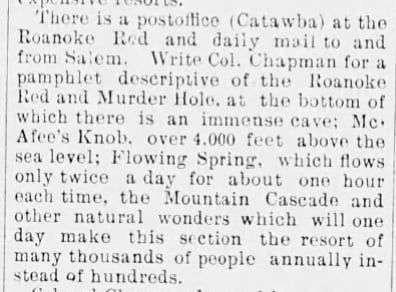
A cave on private property in Catawba that was a popular daytrip spot for locals from Roanoke or a excursion from the nearby Red Sulphur Springs Resort (now the site of Catawba Hospital psychiatric facility) I’ll put the text from one long article below from 1915.
30 minute video on the cave.
https://www.youtube.com/watch?v=AAZ\_dyIK5Nc
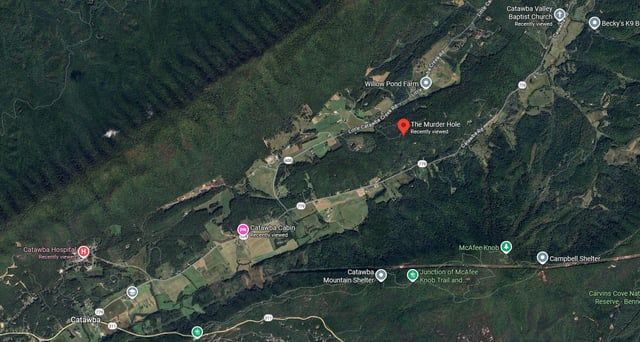
Murder Hole Location in Google Maps
https://www.google.com/maps/place/The+Murder+Hole/@37.4017627,-80.0869618,6870m/data=!3m1!1e3!4m6!3m5!1s0x884d063537f1602f:0x1f7f73efe29b89a3!8m2!3d37.4090206!4d-80.0528216!16s%2Fg%2F1tycxbn3?entry=ttu&g_ep=EgoyMDI2MDcyOC4wIKXMDSoASAFQAw%3D%3D
WSLS Article
https://www.wsls.com/news/2016/04/21/a-look-inside-catwaba-murder-hole-one-of-4100-caves-and-sinkholes-in-virginia/
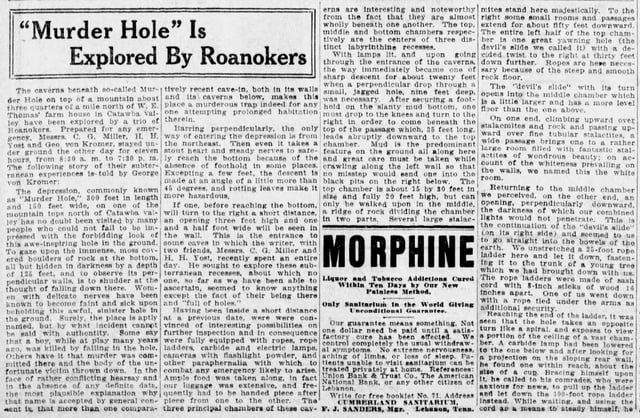
**“Murder Hole” Is Explored By Roanokers**
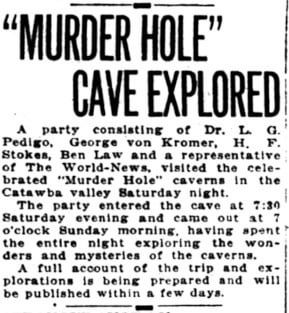
The caverns beneath so-called Murder Hole on top of a mountain about three quarters of a mile north of W. E. Thomas’ farm house in Catawba Valley have been explored by a trio of Roanokers. Prepared for any emergency, Messrs. C. G. Miller, H. H. Yost and Geo. von Kromer, stayed under ground the other day for eleven hours, from 8:30 a. m. to 7:30 p. m. The following story of their subterranean experiences is told by George von Kromer:
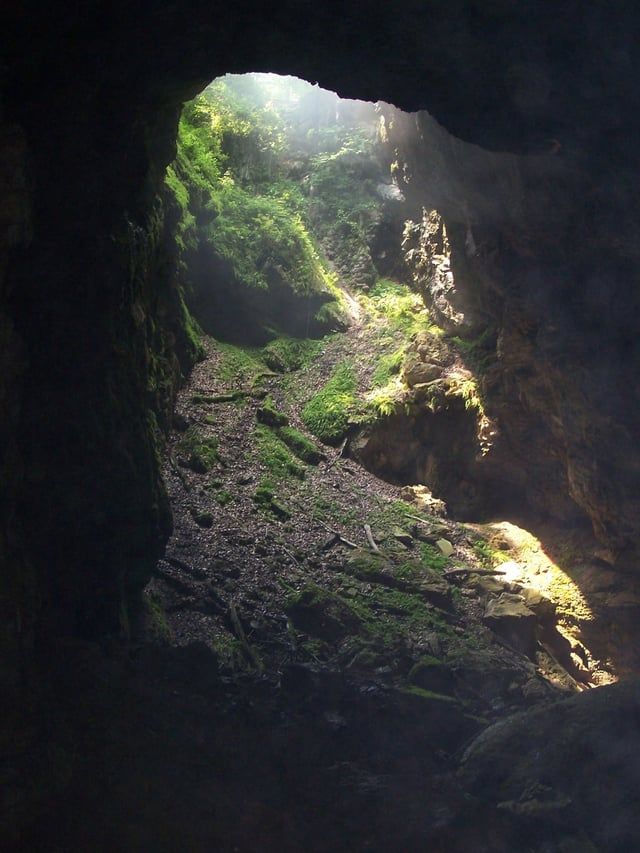
The depression, commonly known as “Murder Hole,” 300 feet in length and 150 feet wide, on one of the mountain tops north of Catawba valley has no doubt been visited by many people who could not fail to be impressed with the forbidding look of this awe-inspiring hole in the ground. To gaze upon the immense, moss covered boulders of rock at the bottom, all but hidden in darkness by a depth of 125 feet, and to observe its perpendicular walls, is to shudder at the thought of falling down there. Women with delicate nerves have been known to become faint and sick upon beholding this awful, sinister hole in the ground. Surely, the place is aptly named, but by what incident cannot be said with authority. Some say that a boy, while at play many years ago, was killed by falling in the hole. Others have it that murder was committed there and the body of the unfortunate victim thrown down. In the face of rather conflicting hearsay and in the absence of any definite data, the most plausible explanation why that name is accepted by general consent is, that more than one comparatively recent cave-in, both in its walls and its caverns below, makes this place a murderous trap indeed for any one attempting prolonged habitation therein.
Barring perpendicularly, the only way of entering the depression is from the northeast. Then even it takes a stout heart and steady nerves to safely reach the bottom because of the absence of foothold in some places. Excepting a few feet, the descent is made at an angle of a little more than 45 degrees, and rotting leaves make it more hazardous.
If one, before reaching the bottom, will turn to the right a short distance, an opening three feet high and one and a half foot wide will be seen in the wall. This is the entrance to some caves in which the writer, with two friends, Messrs. C. G. Miller and H. H. Yost, recently spent an entire day. He sought to explore these subterranean recesses, about which no one, so far as we have been able to ascertain, seemed to know anything except the fact of their being there and “full of holes.”
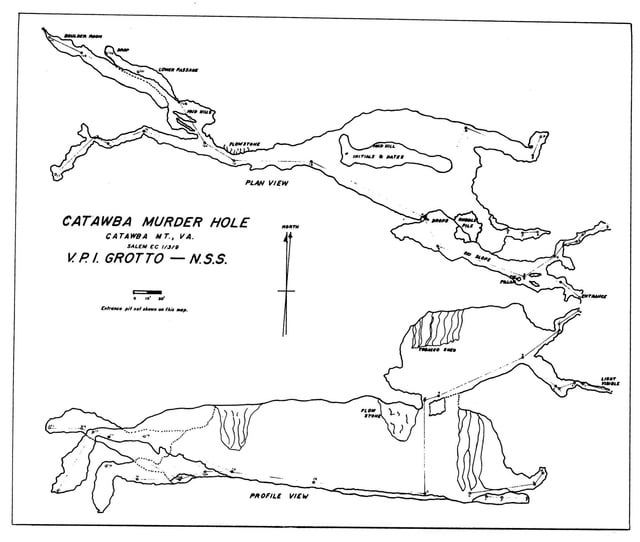
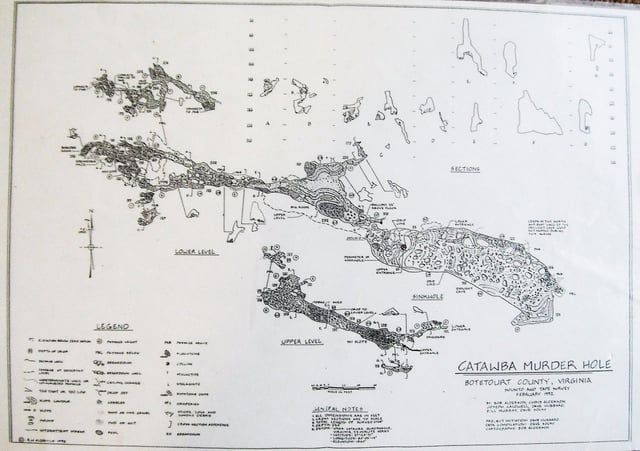
Having been inside a short distance at a previous date, were were convinced of interesting possibilities on further inspection and in consequence were fully equipped with ropes, rope ladders, carbide and electric lamps, cameras with flashlight powder, and other paraphernalia with which to combat any emergency likely to arise. Ample food was taken along, in fact our luggage was extensive, and frequently had to be handed piece after piece from one to the other. The three principal chambers of these caverns are interesting and noteworthy from the fact that they are almost wholly beneath one another. The top, middle and bottom chambers respectively are the centers of three distinct labyrinthine recesses.
With lamps lit, and upon going through the entrance of the caverns, the way immediately became one of sharp descent for about twenty feet when a perpendicular drop through a small, jagged hole, nine feet deep, was necessary. After securing a foothold on the slanty mud bottom, one must drop to the knees and turn to the right in order to come beneath the top of the passage which, 35 feet long, leads abruptly downward to the top chamber. Mud is the predominant feature on the ground all along here and great care must be taken while crawling along the left wall so that no misstep would send one into the black pits on the right below. The top chamber is about 15 by 30 feet in size and fully 20 feet high, but can only be walked upon in the middle, a ridge of rock dividing the chamber in two parts. Several large stalagmites stand here majestically. To the right some small rooms and passages extend for about fifty feet downward. The entire left half of the top chamber is one great yawning hole (the devil’s slide we called it) with a decided twist to the right at thirty feet down further. Ropes are here necessary because of the steep and smooth rock floor.
The “devil’s slide” with its turn opens into the middle chamber which is a little larger and has a more level floor than the one above.
On one end, climbing upward over stalagmites and rock and passing upward over fine tubular stalactites, a wide passage brings one to a rather large room filled with fantastic stalactites of wondrous beauty; on account of the whiteness prevailing on the walls, we named this the white room.
Returning to the middle chamber we perceived, on the other end, an opening, perpendicularly downward, the darkness of which our combined lights would not penetrate. This is the continuation of the “devil’s slide” (on its right side) and seemed to us to go straight into the bowels of the earth. We unstretched a 25-foot rope ladder here and let it down, fastening it to the trunk of a young tree which we had brought down with us. The rope ladders were made of sash cord with 8-inch sticks of wood 16 inches apart. One of us went down with a rope tied under the arms as additional security.
Reaching the end of the ladder, it was seen that the hole takes an opposite turn like a spiral, and exposes to view a portion of the ceiling of a vast chamber. A carbide lamp had been lowered to the one below and after looking for a projection on the sloping rear wall, he found one within reach, about the size of a cup. Bracing himself upon it, he called to his comrades, who were anxious for news, to pull up the ladder and let down the 100-foot rope ladder instead. While waiting, and using the cord as a means to steady himself, he soliloquized upon life’s insecurities in general, and possible immediate punishment for minor indiscretions, in view of the impenetrable darkness of uncertainty below. However, in time, the longer ladder came down and the descent was continued to the bottom. The ladder a little more than reached to a dry knoll in a sea of mud. The luggage tied to a rope was lowered down, after which the other men followed. It was 12:30 o’clock by this time and lunch was made to serve itself. The repast over, we experienced the welcomed diversion of walking, or rather sliding, on more or less level ground. This bottom chamber, uneven in dimensions on account of extensions here and there, is apparently 125 feet wide, over 300 feet long and about 60 feet high, with an extremely slippery substance, glacier mud. Resembling river mud in looks and color, it has the consistency of putty. Little mounds from one to two feet high are everywhere down there, and the deeper places are covered, from two to six inches, with crystal-like water. If slipperyness is one of the desirabilities of a well-appointed ball room, then this bottom chamber could be made to be the finest ball room in the world. Walking there is a ticklish proposition. The farther end of the chamber runs into several passages, the principal one being several hundred feet long, going slightly upward, with crevices here and there.
Probably because of tremendous pressure, this tenacious clay-like substance aforementioned, oozes out of the walls here, forming myriads of adornments for them, of all conceivable shapes and sizes. Whole columns, large and small, standing out or up, would appear to be solid rock, but a finger may be pushed up to it full length or a hand full broken off with ease. Clusters of gorgeous stalactites are seen everywhere, the largest to come under our observation being suspended for about 35 feet from the entrance side of the chamber.
Judging from this and comparing certain facts gathered and calculations made by scientists regarding other caverns, these caverns are as old, if not older, than others in this section of the country. No animal life of any kind was in evidence, except a few bats and some small lizards close to the entrance way above. It is true, at the end of one of the passages leading from the bottom chamber, the skeleton of a small animal (perchance a young ‘possum) is found embedded in half formed rock, due, we believe that the animal fell down the crokscrew hole and died trying to get out. So far as we could discover no human being were ever down there except two, the names of whom evidently were imprinted in the mud with a finger 20 years ago. The inscriptions are “W. H. King, July, 1890,” and “Thayer, July, 1890.” They had been there together, it seems, and the footprints of these two, only were found. We took care not to obliterate the autographs and added our town. The air in the caverns is damp, but otherwise excellent, with a temperature of about 50 degrees Fahrenheit; an inconvenient places were the drops of water regularly trickling down.
The ascent was made with difficulties but without mishaps, though taxing our muscular strength to its utmost capacity.
Scientists tell us that stalactites are formed by carbonates, deposited by drops of water, building at the rate of an inch every century, so that the magnificent large clusters of stalactites we saw must be several thousand years old. And many years before that the cavities must have been formed by agneous energy, which after recession, made the formation of stalactites possible.
While the “Murder Hole” caverns are not as extensive nor so varied in sizes, shapes and numbers than other more famous caverns, there is no absence of all the single and collective beauty of stalactite and stalagmitic formations for which other caverns are known. There are cascades, like foaming cataracts caught in mid air and transformed into transparent amber alabaster; Indian shawls, exquisitely woven, long, hollow blades, “Titan’s swords,” which when sounded, give forth deep sonorous sounds; twig-like projections, lateral outgrowths, to which the name helictite has been applied, are met with uncertain portions of the caves and are interesting by reason of their strange and uncouth contortions. One’s fancy can well imagine so-called “thrones” “Saracens tents,” and other names given to similar formations of magic beauty. Excellent flash light pictures were taken.
The dimensions of the various chambers and passages other than those mentioned, cannot be given on account of the great irregularity of their outlines, both vertical and horizontal. Nor can their size be estimated from a diagram because there are several tiers of galleries with their vertical depths, leading perhaps into larger cavities, other than we have inspected.
Although we have tried to be as thorough as possible on our exploration trip in virgin territory (to us) of Pluto’s domain, we have failed to discover any other out or inlet to these caverns. It is possible, or probable, even, on account of the good air present, that some other means of entrance exists. The possibility also remains that entering passage ways at the bottom, on the level with Catawba valley, and made by receding waters, have been sealed up by an invasion of glacial drift. Marks of that tremendous cataclysm and diluvium deposits are plainly seen at and near the bottom of the caverns.
The theory advanced regarding the formation of Murder Hole itself, is that ageneous energy, after forming the cavities in its recession, undermined the support of certain portions near the top, causing them to collapse. Another theory is that some meteor happened to hit the hollow spot there. However, our magnetic needle was not influenced by the iron which meteors contain and which, in the bulk, large enough to cause such havoc, would not fail to exert some influence. In all probability the former theory is correct.
That “Murder Hole” was once a cavern can be seen by the stalactitic formation on its walls, the surprising fact being their nearness to the top of the ground, high up on a mountain.
Although literally covered with mud from head to foot, and somewhat tired from the continual physical exertion, during our eleven hours stay under ground, we emerged, greeted by the full moon, in good condition and happy at the successful termination of a most enjoyable and instructive trip.”